
How To Measure Donor Churn And Prioritize Supporters Worth Winning Back
Nonprofit organizations invest considerable resources in attracting new donors, yet retaining existing supporters can be just as important to long-term fundraising stability. Understanding why donors stop contributing—and determining which relationships are most promising to rebuild—can help development teams make better use of their limited time and resources.
Donor churn measures the percentage of supporters who stop giving during a defined period. By monitoring this figure and examining individual giving histories, nonprofit organizations can uncover weaknesses in their fundraising strategies and develop more targeted approaches to donor retention.
Step 1: Calculate Your Organization’s Donor Churn Rate
Before attempting to recover lost donors, organizations need to understand the extent of the problem.
For an annual analysis, start by identifying donors who contributed during the previous year. Then determine how many of those same donors made another contribution during the current year.
The calculation is straightforward:
Donor Churn Rate = (Donors Who Did Not Return ÷ Donors in the Previous Period) × 100
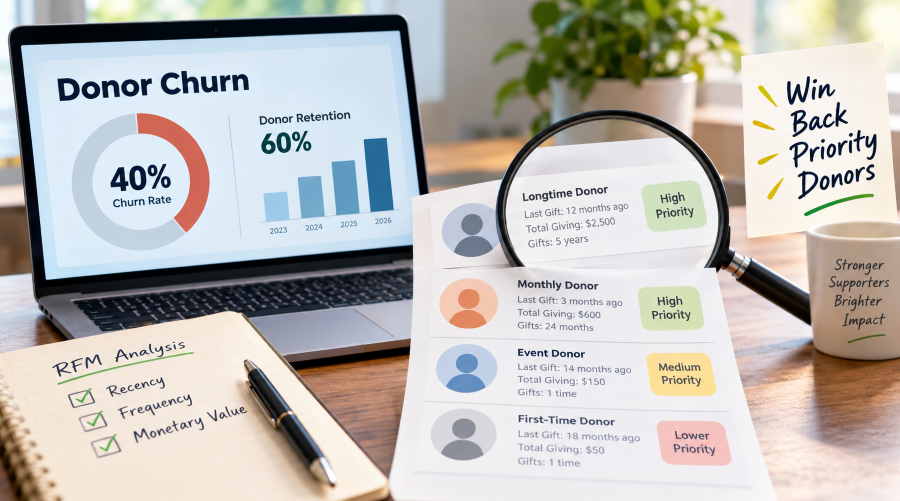
For example, consider an organization with 1,000 donors in 2025. If only 600 of those supporters contributed again in 2026, the organization lost 400 donors.
Its annual donor churn rate would be 40%, while its retention rate would be 60%.
Be sure to compare equivalent, completed giving periods. A donor who typically contributes every December should not automatically be classified as lost simply because they have not donated by October.
Step 2: Separate Donors Into Meaningful Groups
An overall churn percentage offers a useful starting point, but it does not explain which supporters are leaving or why.
Development teams should examine donor retention across several categories:
First-time donors: Individuals who contributed once but have not made a second gift.
Repeat donors: Supporters with an established history of giving who have recently stopped.
Recurring donors: Monthly or quarterly contributors whose scheduled donations have ended.
Major donors: Individuals whose previous contributions represent a significant share of fundraising revenue.
Campaign-specific donors: Supporters who responded to a particular event, emergency appeal, or fundraising initiative.
These categories help nonprofits distinguish between different retention challenges. A first-time donor who never received meaningful follow-up may require a different approach from a longtime supporter whose recurring payment failed.
Step 3: Identify Which Donors to Contact First
Not every lapsed donor should receive the same level of attention.
A practical approach is to evaluate supporters using three factors:
Recency: How long has it been since their most recent contribution?
Frequency: How consistently have they donated in the past?
Monetary value: How much have they contributed over time?
Together, these measurements are commonly called RFM analysis—recency, frequency, and monetary value.
Organizations can use this information to establish an initial outreach priority.
For example, a donor who contributed annually for five consecutive years but missed their most recent gift may be a stronger candidate for personal follow-up than someone who made a single small donation many years ago.
Similarly, a longtime monthly donor whose credit card expired should receive prompt attention because the interruption may be administrative rather than intentional.
Gift history should guide outreach without becoming the only consideration. Volunteer participation, event attendance, program interests, and existing relationships can also indicate whether a supporter remains connected to the mission.
Step 4: Determine Why Donors Stopped Giving
Once priority groups have been identified, development teams should investigate possible reasons for donor inactivity.
Common contributing factors include insufficient acknowledgment, generic communications, limited information about the impact of donations, and missed opportunities to build ongoing relationships.
Payment processing problems can also interrupt recurring contributions.
These situations require different responses.
A donor whose payment failed may simply need a secure way to update billing information. Someone who has gradually disengaged may need a more personal conversation about the organization’s work and accomplishments.
Rather than assuming every lapsed donor has lost interest, nonprofits should review contact histories, communication preferences, and available engagement information before deciding on a recovery strategy.
Step 5: Create a Targeted Donor Re-Engagement Plan
Once the organization understands its donor segments, it can develop outreach tailored to each group.
For recently lapsed supporters, a personalized email highlighting recent accomplishments may help reestablish contact.
Longtime donors may warrant a personal telephone call or letter acknowledging their history of support.
First-time donors who have not returned may benefit from a series of communications explaining how their original contribution supported the organization’s mission.
For recurring donors with interrupted payments, the priority should be resolving the transaction issue rather than treating the situation as a traditional fundraising appeal.
Each communication should emphasize the donor’s relationship with the organization—not simply request another contribution.
Organizations should also honor requests to stop receiving solicitations and avoid repeatedly contacting individuals who have expressed a desire to disengage.
Step 6: Track Whether Recovery Efforts Are Working
Re-engagement efforts should be measured just as carefully as donor acquisition campaigns.
Useful performance indicators include:
Donor reactivation rate: The percentage of contacted lapsed donors who resume giving.
Recovered revenue: The total contributions received from reactivated supporters.
Outreach response rate: The percentage of donors who respond to emails, telephone calls, or other communications.
Retention following reactivation: The percentage of recovered donors who continue giving in a subsequent period.
For example, if an organization contacts 200 lapsed donors and 30 make another contribution, its reactivation rate for that outreach group is 15%.
Tracking these results allows development teams to refine their strategies, identify effective communication methods, and avoid devoting resources to approaches that produce little engagement.
Step 7: Use What You Learn to Prevent Future Donor Losses
Recovering inactive donors is valuable, but preventing supporters from disengaging should remain an ongoing priority.
Organizations can improve retention by acknowledging contributions promptly, communicating the results of donor support, maintaining accurate donor records, and creating convenient opportunities for recurring giving.
Automated reminders and follow-up communications can support these efforts, particularly for organizations managing large donor databases with limited staff.
However, automation should complement rather than replace personal relationships.
The most effective donor retention programs combine reliable information with consistent, meaningful engagement.
Turning Donor Data Into Stronger Relationships
Donor churn should be treated as more than a fundraising statistic. It can reveal whether supporters feel informed, appreciated, and connected to an organization’s mission.
By regularly analyzing giving patterns, identifying promising re-engagement opportunities, and measuring the results of outreach, nonprofit leaders can make more informed decisions about where to invest their development resources.
A thoughtful donor retention strategy does not eliminate donor losses. It helps organizations recognize when important relationships are at risk and respond before those connections disappear entirely.
Source: CharityEngine